Latest news and interesting articles
We invite you to browse through our news pages to catch up with the latest news about crossXculture as well as related issues from around the globe.
10.02.2026
The Hidden Cost of Bang for Buck
In our modern affluent societies, economic decisions are increasingly guided by a single, seemingly rational principle.
We are children, free from guilt and experience.
In our modern affluent societies, economic decisions are increasingly guided by a single, seemingly rational principle: getting the maximum return at the lowest possible cost.
Comparing prices has become a passionate hunt for individuals and corporations alike.
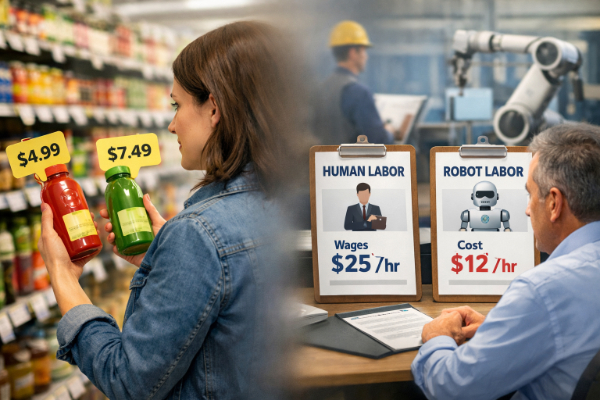
To the shopper, the weapons are international platforms that undercut the prices of any local offer. And to companies providing jobs, automation, outsourcing, and artificial intelligence promise to provide the better deal than human labour. This pursuit of “bang for buck” is celebrated as smart, objective, and necessary in a competitive global market. However, beneath this surface logic lies a systemic problem.
Caution: We are lighting the candle at both ends.
When price becomes the dominant criterion and personal engagement disappears as the consequence of a widely accepted popular “sport”, the long-term financial and social foundations of society crumble.
Historically, economic activity was embedded in social relationships. Buying goods, hiring workers, or offering services involved trust, mutual dependence, and a sense of shared responsibility. A local shopkeeper knew their customers. Employers understood that paying fair wages helped sustain the very community that supported their business. These relationships created informal but powerful “strings attached”: loyalty, accountability, and social cohesion.
Today, many of these connections have been replaced by anonymity and algorithms. Online platforms allow consumers to purchase goods from distant producers they will never meet. Employers can replace workers with machines or cheaper labour abroad without witnessing the human consequences of their decisions.
While this system can be seen to deliver short-term savings, it also removes personal engagement and the all-important moral feedback from economic choices. The result is a paradox. Societies that are materially wealthy are experiencing increasing financial insecurity, social fragmentation, and declining trust.
What we are seeing today is that wages stagnate while profits concentrate. Communities weaken as local businesses disappear. Individuals, although surrounded by digital connectivity, are living ever more isolated lives, often completely unaware of how their everyday decisions contribute to these outcomes and cement a gloomy downward spiral.
This is where the old ethical principle “what goes around comes around” becomes especially relevant. Often described as the Golden Rule, it reminds us that actions taken without regard for others eventually bounce back to affect us, directly or indirectly. Paying the lowest possible price may seem harmless, but if it contributes to underpaid labour, weakened local economies, or job losses, the long-term consequences are shared by everyone. Reduced purchasing power, social tension, and economic instability are the outcome.
In earlier times, these consequences were more visible. Exploiting a neighbour meant having to look them in the face the next day. Today, the distance between action and outcome creates the illusion that individuals are unaffected by the system they create and participate in. This illusion is dangerous and at best short-lived. Isolation does not remove responsibility; it merely delays its effects.
For a healthy society, economic efficiency must be balanced with social commitment. Fair wages, ethical production, and responsible consumption are not sentimental ideals of “wishful dreamers” but longterm investments in stability. Only when individuals and institutions acknowledge that their choices have wider consequences, they help preserve the conditions that made prosperity possible in the first place.
A society of bargain hunters is not sustainable.
Education plays a crucial role in this awareness. Language learning, in particular, connects students to their own and foreign cultures, forms new perspectives, and encourages consequential ways of life. It reminds us that behind every product, service, or message stands a human being. By fostering empathy and critical thinking, education counteracts the narrow logic of cost alone.
In an age of apparent independence and isolation, the principle of “what goes around comes around” is not outdated—it is a powerful and essential learning experience. Prosperity that ignores social responsibility is fragile from within. Only by recognising our mutual dependence can affluent societies avoid financial and social decline and move toward a more sustainable future.
This is what it's about. How do we get out?
crossXculture.com
Good news for you.